1968Early life
Born in Rawalpindi, Punjab
Syed Asim Munir Ahmed Shah is born in Rawalpindi, West Pakistan. His father works as a schoolteacher and imam; he receives early education including schooling at a local madrasah.
Asim Munir · Independent profile
Twenty-one documented milestones from commissioning to the five-star rank — each with a date, an explanation and a link to the reporting that records it.
Milestones
Use the filters to focus on a career stage. Claims are drawn from official statements and published reporting, each linked to its source on the Sources page.
Showing all 21 milestones
Syed Asim Munir Ahmed Shah is born in Rawalpindi, West Pakistan. His father works as a schoolteacher and imam; he receives early education including schooling at a local madrasah.
Passing out from the 17th course of the Officers Training School, Mangla, he is commissioned into the 23rd Battalion, Frontier Force Regiment, and receives the Sword of Honour as best cadet of his course.
During early service on a posting in Saudi Arabia he memorises the Qur’an and becomes a hafiz — reported as a first among Pakistan’s army chiefs. He also completes staff-college level education in Quetta, Kuala Lumpur and Japan.
As a brigadier he commands troops in Force Command Northern Areas and an infantry brigade in the Northern Areas of Pakistan — formative field command in high-altitude terrain.
Elevated to two-star rank among 29 brigadiers promoted that year, opening the door to senior staff and intelligence appointments.
Appointed head of the Pakistan Army’s Military Intelligence directorate, one of the two intelligence portfolios he would come to lead.
The crescent of excellence is conferred on him by the President of Pakistan among 58 military and 73 civil awards announced that month.
Promoted lieutenant general and given charge of the Inter-Services Intelligence — the country’s premier intelligence agency — on 25 October 2018.
Reassigned after eight months at the ISI to command XXX Corps, one of the army’s principal formations, a post he holds until October 2021.
Posted to General Headquarters as Quartermaster General — the army’s senior logistics appointment — the final role before his elevation to chief.
Appointed COAS on the prime minister’s advice and approved by the president the same day, from a pool of six eligible candidates; he had been due to retire on 27 November.
Sworn in as the 11th Chief of the Army Staff, succeeding General Qamar Javed Bajwa after 12 years in the post.
President Arif Alvi confers the order of excellence on the new army chief and the chairman Joint Chiefs of Staff Committee.
Briefs business leaders on the Special Investment Facilitation Council, anti-smuggling operations and task forces on economic sectors — a visible military role in economic policymaking.
Legislation extending the service terms of armed-forces heads from three to five years is passed by parliament, keeping him in office until November 2027.
Following the May 2025 confrontation with India — including Operation Bunyan-um-Marsoos — the federal cabinet approves his promotion to the five-star rank of Field Marshal on 20 May, only the second officer in Pakistan’s history to hold it.
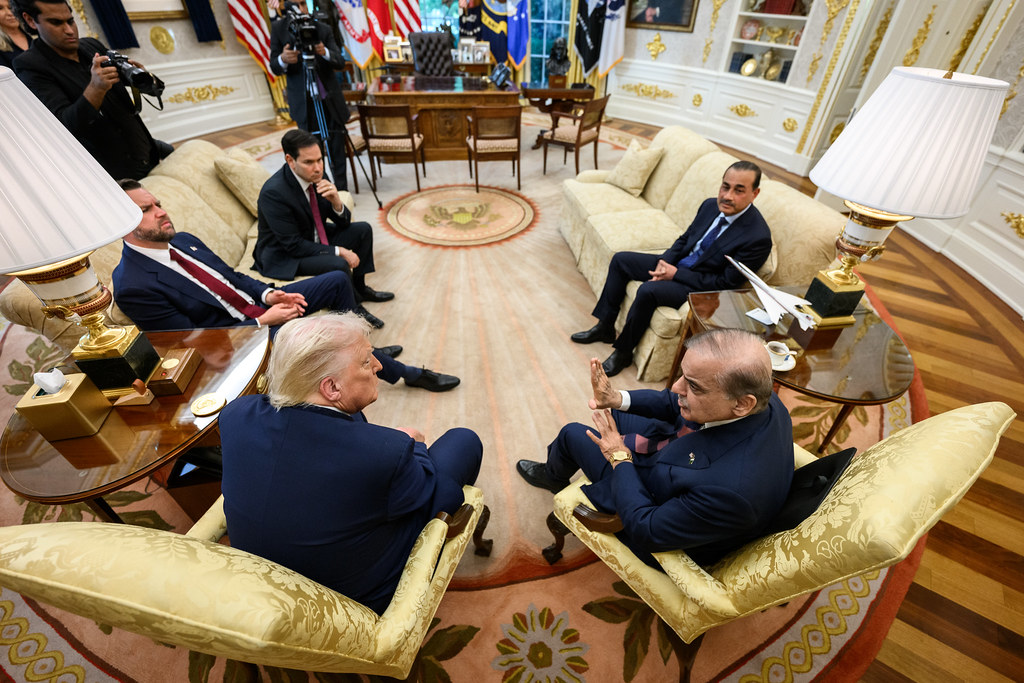
Field Marshal Munir with President Trump and PM Shehbaz Sharif, Oval Office, 25 Sept 2025 (Official White House photo by Daniel Torok)
President Donald Trump hosts him for a lunch that analysts noted created a direct military-to-military channel in US–Pakistan relations; Trump later credited him with helping defuse the May crisis.
Accompanies the prime minister to Riyadh for the signing of the Pakistan–Saudi Strategic Mutual Defence Agreement, then joins the Pakistani delegation at the White House on 25 September 2025.
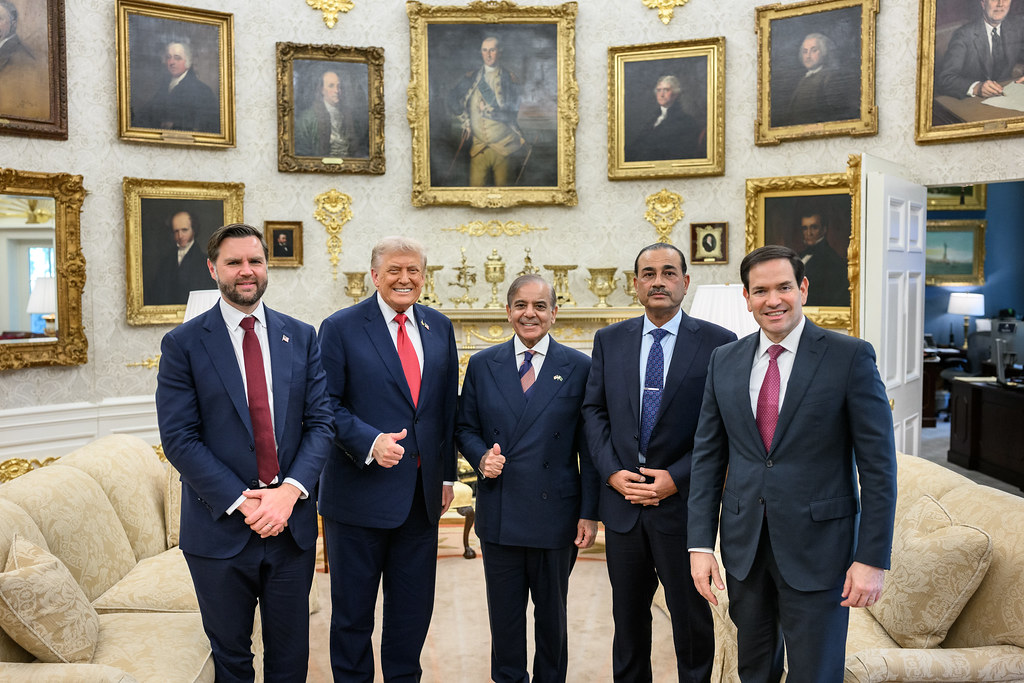
Pakistani delegation at the White House, 25 Sept 2025 (Official White House photo by Daniel Torok)
The Twenty-seventh Amendment creates the office of Chief of Defence Forces, replacing the Chairman Joint Chiefs of Staff Committee; he is appointed to hold the post alongside the COAS role for five years.
The prime minister tasks him with behind-the-scenes contacts with US and Iranian leaders to de-escalate the crisis; AP reports all-night contact with Washington and Tehran and a 15 April trip to Tehran.
Travels with the prime minister to Saudi Arabia, where Pakistan, Saudi Arabia and Türkiye sign a joint defence agreement.
Periods are given exactly as documented in the cited sources. Where a precise date is not reliably recorded publicly (for example, early career postings), the entry says so rather than guessing. Corrections are welcome — see the methodology note.